


The Mountain, Not the Loop
Every donor engagement model I have been handed looks the same. A circle. Identify, cultivate, solicit, steward, and back around to the top. Four or five arrows chasing each other, drawn in the organization’s brand colors, printed for the board retreat. The circle is not wrong. It is just describing what the organization does. Personally, I think the donor side looks more like a ski mountain.
One lodge, many ways down.
Picture the mountain. There is one lodge at the base. There are lifts. There are runs of every grade coming off the same summit, and a wide easy slope on the near side, and a bunny hill by the parking lot, and a fire inside with people who never put boots on (this is me!).
Everyone on that mountain paid to be there. Everyone is having a legitimate day.

Somebody takes the bunny slope for three seasons running and is completely content. Somebody gets off the lift and goes straight to the steepest run because that is what she came for and she is annoyed if you slow her down. A family rides up together and splits at the top. One person sits by the fire the entire trip, watches, and comes back every single year.
None of them are behind. They are on different runs.
The circle model cannot hold that. It assumes the sustainer of nine years and the first-time gala attendee are at different points on the same track, moving the same direction, and that the job is to move everyone up. So we build a calendar that pushes the whole file toward one summit at one pace, and when someone does not climb, we file it under disengagement and send another email.
She was not disengaged. She was on the blue run, enjoying herself, being asked to ski a double black.
What segmentation is actually doing.
Most segmentation in the sector runs on capacity. How much can this person give. Wealth screening produces a number, the number produces a tier, the tier produces a touch plan.
Capacity is real information and I am not arguing against it. But capacity only tells you how high the lift goes. It tells you nothing about which run this person wants to be on when she gets off it.
Two questions do that work:
- How do you want to be asked. Mail. Email. In person over coffee. Not at all, because you would rather give through your donor advised fund on your own schedule and be left alone until December. Once a year. Never by phone.
- How do you want to be thanked. Publicly, with your name in the report, because recognition is part of why you give. Privately, because a public listing makes you uncomfortable. With a number showing what the gift did. With a handwritten note. With nothing, because the thank-you costs more staff time than you want spent on you.
Those two answers sort a file more usefully than capacity does, because they are about the experience and capacity is about the transaction. The organizations that ask them get a donor who feels recognized. The organizations that do not get a donor who quietly stops opening the mail and cannot tell you why.
The runs.
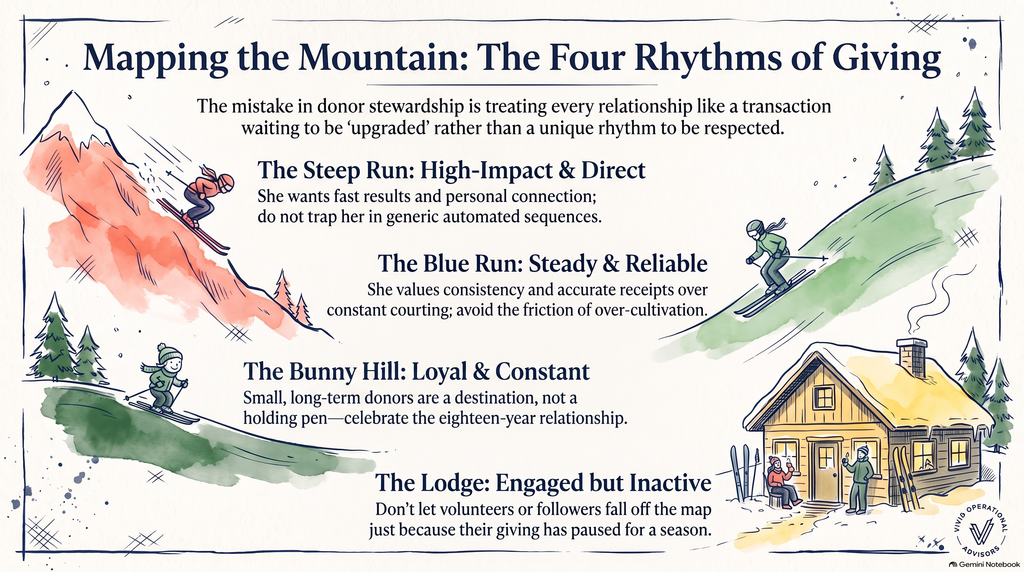
The steep run. She knows what she wants, she wants it fast, and she wants a person. This is the donor who will take a meeting, ask hard questions, and give more than the screening predicted, provided you do not route her through a stewardship sequence built for a first-time giver. Mishandling this donor looks like sending her the same appeal as everyone else and wondering why she went quiet.
The blue run. Steady. Reliable. Gives on the same rhythm every year without a great deal of intervention, and appreciates being kept informed rather than courted. The failure here is neglect on one side and over-cultivation on the other. She does not need four touches a quarter. She needs the mail to arrive when it always arrives and the receipt to be right.
The bunny hill. New, or small, or both, and perfectly happy. Some of these people will move up the mountain and most will not, and the ones who stay are not a failure of the program. A donor who gives fifty dollars a year for eighteen years is an eighteen-year relationship. The mistake is treating the bunny hill as a holding pen rather than a destination.
The lodge. Not giving right now. Volunteering, attending, reading, watching. Something happened this year, or the priority shifted, or the money went somewhere else for a season. The circle model has no square for this person, so she falls off the map entirely.
What you build for the person who is not climbing.
Every ski resort understands the lodge is not overhead. It is the reason people come back in a year when the snow is bad.
Nonprofits rarely build one. We build for the ask and the close, and when a donor lapses we run a reactivation appeal, which is roughly the equivalent of standing in the parking lot handing skis to someone who came to sit by the fire.
The lodge in practice is the thing that keeps a relationship warm with no ask attached. A note when something she cared about got funded. An invitation to the volunteer day. The annual report arriving whether or not she gave this year. It is cheap and it is not glamorous and it is almost never on anyone’s calendar because it does not show up in this quarter’s number.
It shows up in next year’s.
What to do on Monday.
You do not need a new CRM to start this. You need two fields and the discipline to fill them.
- Add a preferred contact method field and a preferred recognition field to your constituent record.
- Ask the questions in the places you already talk to people, which means the event registration form, the sustainer sign-up, the stewardship call, the survey you send once a year anyway.
- Fill them in as the answers arrive. Do not wait to have a complete file.
- Run one segment against the answers before you run the next appeal, and see how much of your list was being asked in a way it never wanted to be asked.
The circle is a picture of your process. It was never a picture of your donors.
If your segments are built entirely on gift size, you are not segmenting. You are sorting.
Erin Peshoff is the Founder of Vivid Operational Advisors. She has spent thirty years inside nonprofit operations, helped raise over $100 million for institutional missions, and built Vivid around the operating discipline most strategic engagements skip.