Your mission is not the problem. The infrastructure holding it together is.
OPERATIONS WITH A FUNDRAISER’S EYE
For NONPROFIT Organizations.
SOUND FAMILIAR?
It is only Tuesday and I am already behind.
Three people know how this works. One is burning out.
We got the grant. Now we have to deliver it.
We did not hit goal and nobody can tell me why.
Those are four sentences, and most organizations hear all four in the same month, which is the part worth noticing. They are not four problems that arrived separately and can be solved separately. They are one problem surfacing in four places, and the place is the infrastructure underneath the work rather than the work itself. The people saying these things are not underperforming, they are carrying a system that stopped fitting the organization somewhere back and never got rebuilt, and they are covering the gap with their own hours because nobody has named it out loud.
Why we love nonprofits.
The people who show up for this work want to help people. That is the whole qualifying criterion, and it is the part of the world we get to choose. Whatever is happening in the economy or on the news, we can still stand up nonprofits, take care of them and do the work inside them. We have spent 28 years in the chair, and we know what your team carries. Most of it should not be this hard.
THE MISSION
Every day, someone gets help because your team showed up. That never gets old to us.
THE PEOPLE
The best people I know work at nonprofits. They carry a lot, and they do it with heart.
THE GENEROSITY
Clean records and reports your board believes, so the conversation goes back to the mission.
Very few people go into nonprofit work because they love change. They go into it to change the world, and we write about how to make room for both.
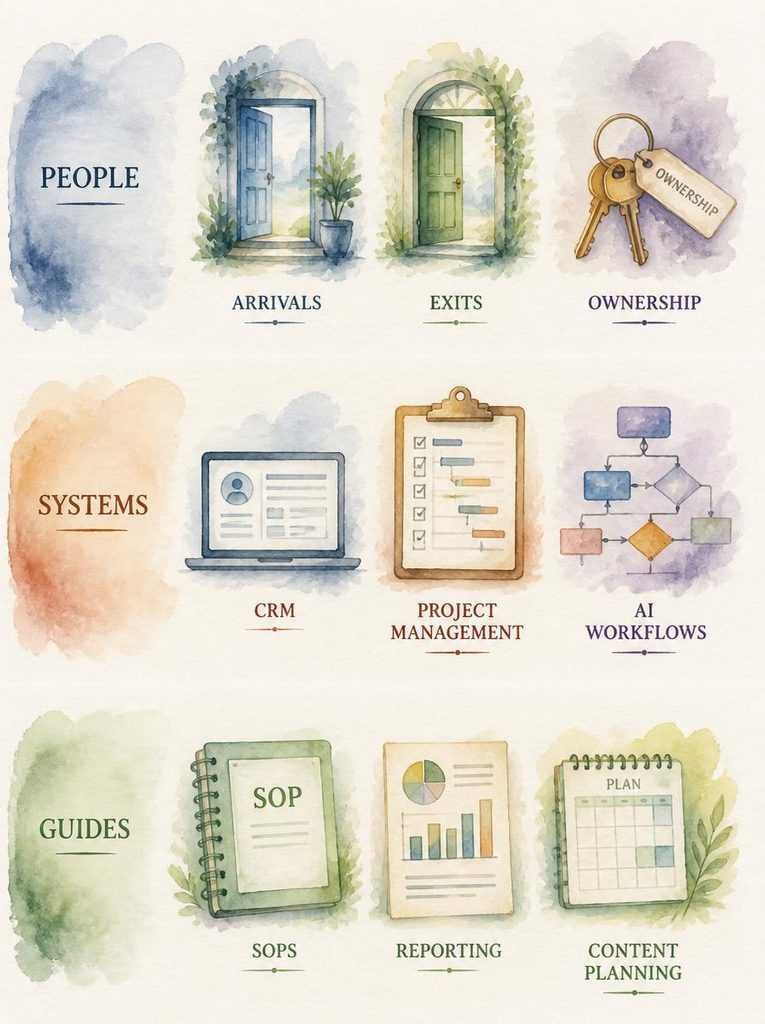
Operations is a big word, so we broke it into nine systems in three groups. People own the work, systems run the work and guides document the work. Most people already know which square has been giving them trouble.
Nine systems sit underneath every fundraising operation. Three of them are about people, meaning arrivals, exits, and ownership. Three are tools, meaning your CRM, project management, and AI workflows. Three are guides, meaning SOPs, reporting, and content planning. Nine questions, one for each, and you will know which ones are holding and which ones are running on one person. Nothing gets sent to us, and nothing about this is a pitch. It is the same read we run at the start of every engagement, in the short version you can do yourself in about five minutes.
The Editor-Architect Framework
Your CRM and your onboarding are almost never at the same stage.
Nine systems sit underneath how your organization runs, and they mature at different speeds. One is protected. Two are still running on somebody’s memory. Most organizations have never looked at them side by side.
This places each of the nine. It takes about five minutes, and there is nothing to fix by the end of it, only something to see.
What an operations review usually produces
A list of everything broken and a plan to build more.
What this one produces
A stage for each system, including the ones that are already fine and should be left alone.
Question 1 of 9
People · Arrivals
When a new person joins your team, what happens?
People · Exits
When someone leaves, what happens to what they carried?
People · Ownership
Who decides things, and how clear is that?
Tools · CRM
What is your CRM to you, honestly?
Tools · Project management
How does work move through your organization?
Tools · AI workflows
Where does AI sit in how you run?
Guides · SOPs
Where do your workflows actually live?
Guides · Reporting
When you need to know how things are going, what happens?
Guides · Content planning
How do your donor communications run?
Your read
Your operation is holding, and it is running through people more than systems.
That is the frontier, not a failure. The work is getting done. What is missing is the system underneath it, and that is the most buildable problem there is.
Most of your operation is steady. One or two systems are carrying more strain than the rest.
Steady is a real accomplishment. It is also the state that never generates its own reason to move. The systems below the line are where the next gain is.
Your infrastructure is in strong shape. What is left is refinement, not repair.
You have built more than most organizations ever reach. The domains below are the last edges, not open wounds.
People
The systems that govern who joins, who leaves, and who decides.
Arrivals
Exits
Ownership
Tools
The systems that hold and move the actual work.
CRM
Project Management
AI Workflows
Guides
The systems that make the work repeatable, visible, and paced.
SOPs
Reporting
Content Planning
Where to Start
People
Arrivals. A designed arrival means a new hire’s first weeks look the same no matter who runs them.
Exits. A real offboarding means a departure changes who signs the letter, not whether the donor hears from you.
Ownership. Clear ownership means the organization stops running through one person.
Tools
CRM. A CRM that works means no year-end surprise about who quietly stopped giving.
Project Management. A real project system means you learn about a problem before someone has to confess it.
AI Workflows. An AI plan means the repeatable work gets carried by a machine, not by your people.
Guides
SOPs. Documented workflows mean the answer to how a thing gets done is a document, not a person.
Reporting. Defined reporting means the numbers arrive before the board asks for them.
Content Planning. A real communications calendar means no donor’s experience depends on which month they gave.
How we work.
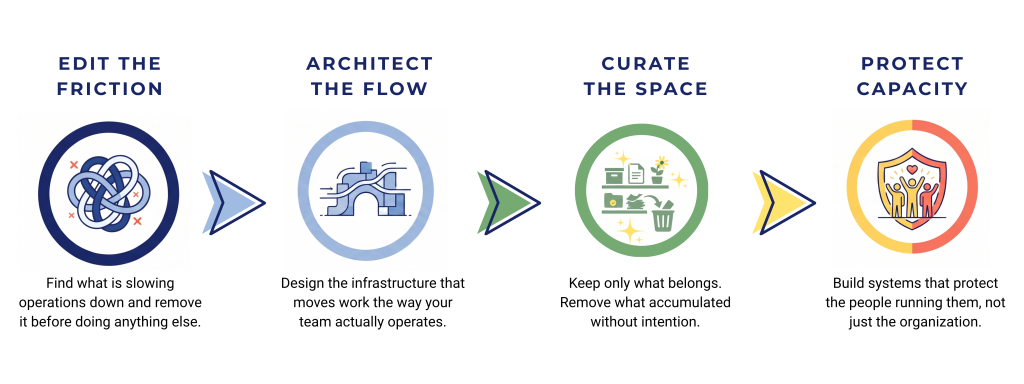
We start by taking out what is in the way. Then we build around how your team works. Every month you get a Map that shows what came off your plate.
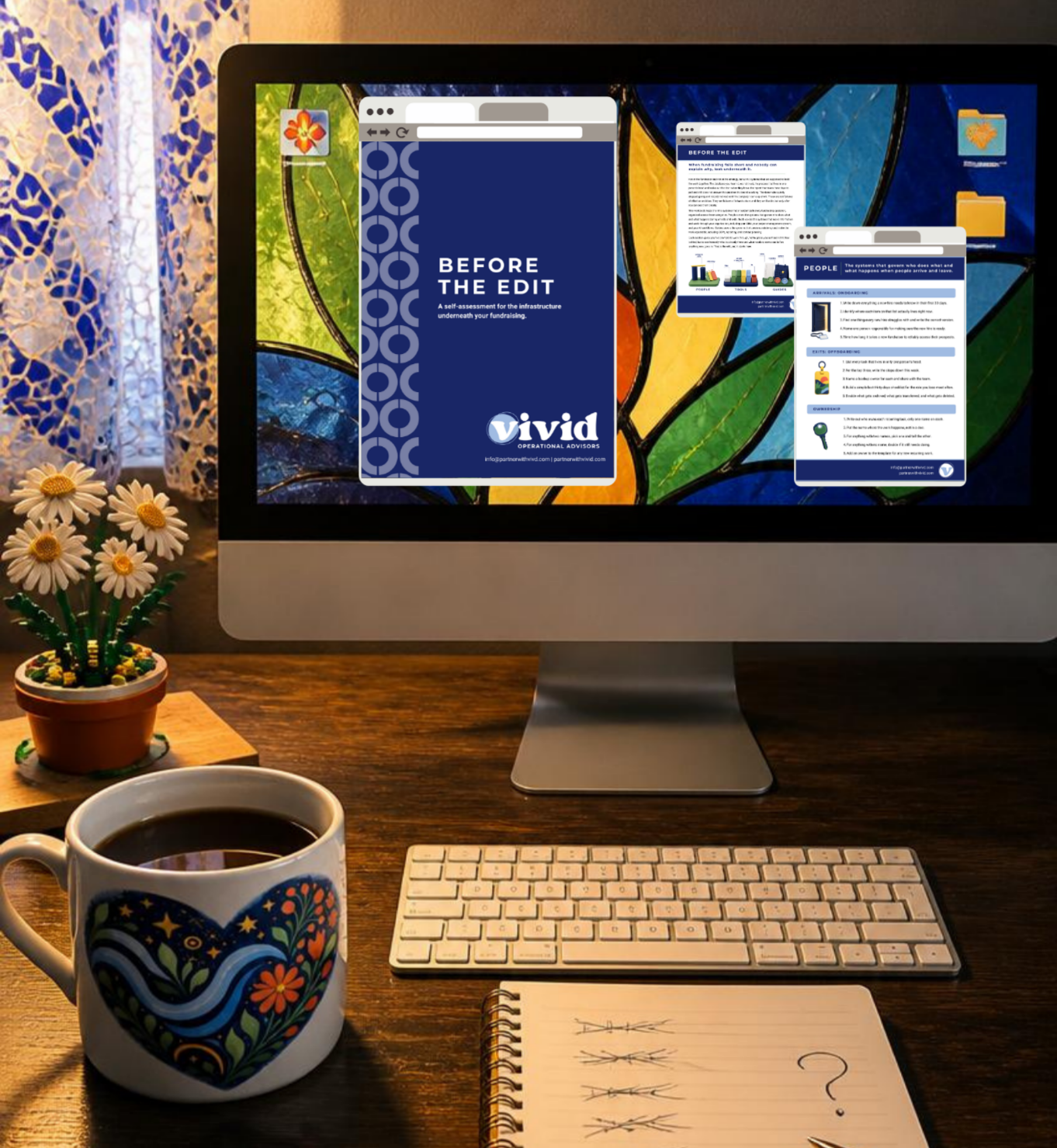
When fundraising falls short and nobody can explain why, look underneath it.
Before the Edit walks you through the nine systems that sit under every fundraising operation, one at a time, so you can see for yourself what is already there and what needs to come out before anything new goes in. Download your copy and do the first look yourself.