
OPERATIONS AUDIT
Start with the problem you keep naming.
You have probably said one of these out loud.
- Someone left and took the system with them.
- Our operations are not ready for our new strategic plan.
- I am new in the seat and do not trust what I inherited.
- We are mid-campaign and the systems were never built for this volume.
- My gift officers are spending more time managing the system than managing their portfolios.
How this works.
You bring the problem. We read it from the outside, the way someone who has sat in the CDO chair and knows which operational problem is actually a donor retention problem in disguise. We work the problem together in a focused session, then send you the pathway. The read is done before the conversation starts, so the time together is spent deciding, not catching up.
What the AUDIT Includes.
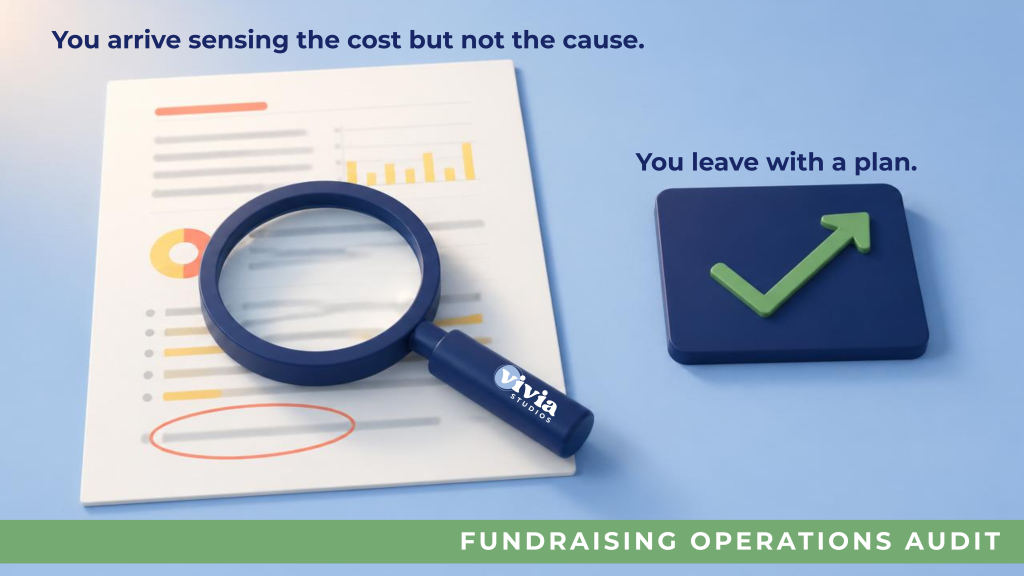
A decision and a sequence. You know what is generating cost without generating motion, what to do first, and what to leave alone. The pathway is written to hand to your team, your board, or whoever comes next, without translation.
|
Element |
Impact |
Result |
|
The Read |
Names where the operation is costing you |
You see what staying stuck is actually costing |
|
The Decision |
One move to make first, chosen for the fastest return |
You fix the costliest thing first |
|
The Handoff |
A pathway anyone can pick up |
Your board and team see a plan, not a scramble |
Where the AUDIT stops.
The audit ends at the decision and the sequence. It does not build the system and it does not run it. When you are ready to put the decision into motion, the Infrastructure Build builds it. When you want it carried across the organization, the Operational Transition carries it. The audit is where you find out what is true, fast, for less than the cost of staying stuck.
Your investment.
This is the starting point for organizations like yours. Book a time and we will map it to what you actually need.