


The calendar was full of good things, which was the problem
Last week I sat down with someone I trust and said out loud what I want the business to look like. Three clients at a time. Enough revenue that the mortgage is boring. Room left over to make things up, because making things up is the part I actually like. An island in three to five years, once my son is out of high school and off doing whatever he is going to do.
Then he asked what I was doing to get there, and I heard myself describe a month with somewhere between twenty five and forty meetings in it. Not bad meetings. That is the part worth saying clearly. Every one of them was a real person, a warm introduction, a conversation I was glad to have. There was nothing to cancel on the grounds that it was junk, because none of it was junk. It had simply accumulated, one reasonable yes at a time, until the thing I said mattered most had nowhere to sit.
Nothing was broken, which is exactly the problem
When a system is broken, somebody complains. Reports come out wrong, a gift gets missed, a handoff drops, and the noise brings you to the thing that needs fixing. When a system is merely full, nobody complains at all. It runs. It runs well, in fact, which is what lets it keep taking on more, because a well run container fills faster than a messy one and every new thing that arrives looks defensible on the day it arrives.
The order is the whole thing
When I finally ran the four moves on my own week, the sequence did most of the work.
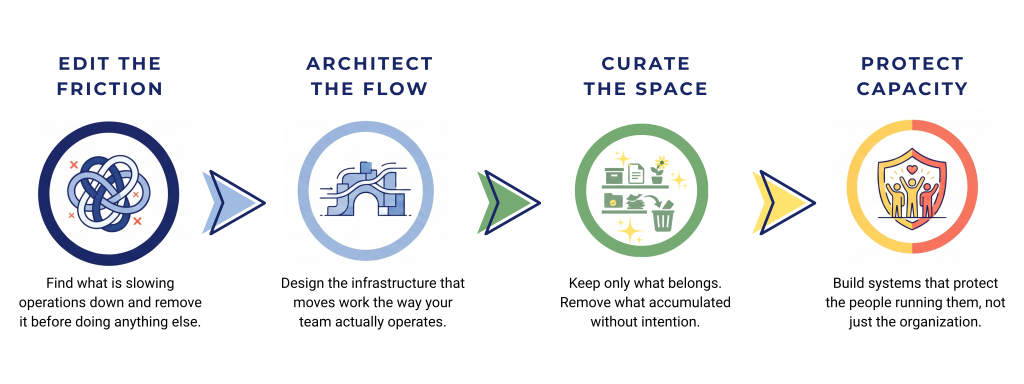
- Edit the Friction meant looking first. Not cancelling, not restructuring, just counting. How many recurring commitments, and which one would I miss least. That took ten minutes and I had been avoiding it for a season.
- Architect the Flow meant saying what a good week looks like. I had never written it down. When I did, it turned out I wanted the creative work in the morning and the conversations stacked in the afternoon, which is not remotely how the calendar was arranged.
- Curate the Space was the first move that changed anything. One recurring thing came off. Not a strategy, one thing.
- Protect Capacity was a number and a date. What tells me it is getting too full, and when do I look. Because I know what happens to reclaimed time when nobody is watching it.
Four moves. Maybe an hour of actual work across the whole thing. The reason it had not happened before is that it looked like it would take a month, and things that look like they take a month do not get started.
Why we built a tool for it
We use this framework on operations considerably larger than one person’s calendar. Nine systems, whole development shops, transitions where somebody is walking out the door with the only copy of how anything works. But the moves do not change with scale, and the thing that keeps people stuck is the same at every size. The fix looks enormous, so nothing moves.
One Small Thing is the framework at its smallest. You bring a goal, you answer four questions, and you leave with an order of operations rather than an assessment. Four minutes, and nothing in it asks you to overhaul anything. Pick one thing. Just one. Put the rest in a folder and go do that one thing well.
Erin Peshoff is the Founder of Vivid Operational Advisors. She has spent thirty years inside nonprofit operations, helped raise over $100 million for institutional missions, and built Vivid around the operating discipline most strategic engagements skip.