

The Missing Operating Layer
Here’s what I know is happening all over our sector because I hear about it at least once a month. Someone bought a new CRM in the spring, and by fall half the team is back in their own spreadsheets. (TLDR: the reports don’t match and everyone’s a little embarrassed.)
I have yet to get on a call with someone who’s like, oh my gosh, I love my database so much. It doesn’t happen. And nobody did anything wrong here. Stuff just got built on top of stuff, kind of like the Weasley house in Harry Potter, where they kept adding a room on the side every time they needed space. It’s still standing. It’s just not a house you want to live in.
Everybody’s adding something.
TBH…. right now everybody’s adding.
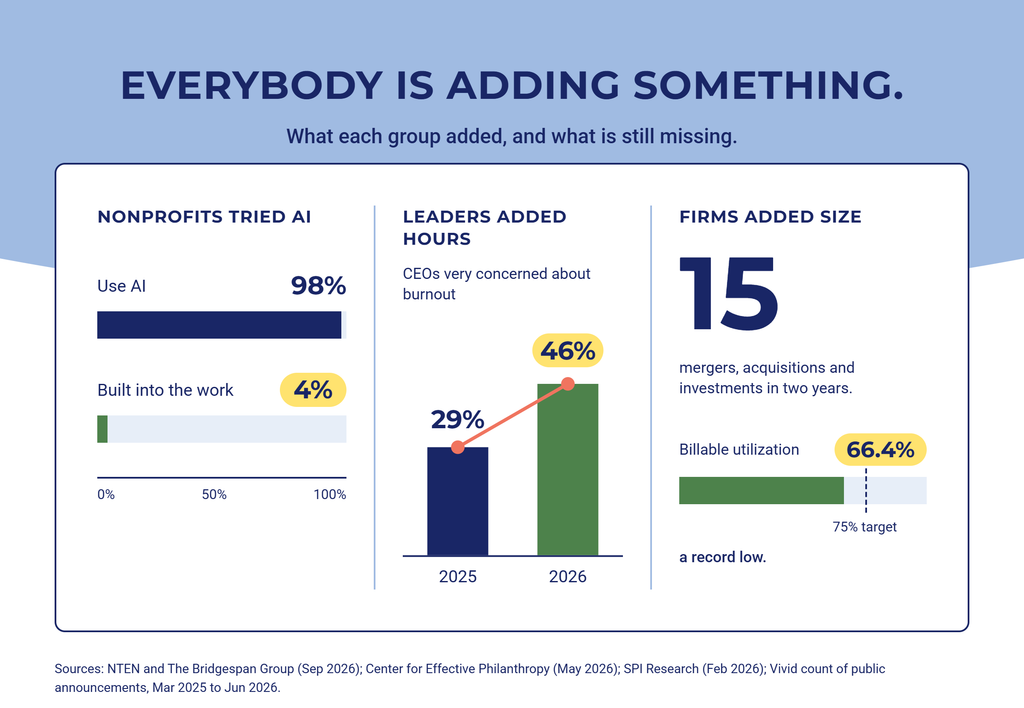
Nonprofits are adding tools. NTEN and The Bridgespan Group put out a study in September that found 98% of nonprofits are using AI, and only 4% have it built into how the work actually gets done. (I always say AI is an overeager intern. If you don’t give it guardrails, it just goes.)
Leaders are adding hours. The Center for Effective Philanthropy found 46% of nonprofit CEOs say burnout is very much a concern this year. Last year it was 29%.
And the firms that serve nonprofits, mine included, are adding size. I counted 15 mergers, acquisitions and investments in our space in the last two years. Meanwhile SPI Research found billable utilization at professional services firms hit a record low. So we’re getting bigger, but we’re not running any better.
So what’s Missing?
The part nobody’s adding is the stuff underneath. Who owns this system? What are the steps, start to finish? Where do the answers live, so the next person can find them without asking you 9 bazillion questions?
When that’s missing, you pay what I call a chaos tax (and it’s a real thing – check out my friend Caity’s new product ImpactHub). New tools make more work. People leave and take everything in their heads with them. And when two firms merge, now you’ve got two of every mess.
The tricky thing is no one knows their systems are messy until someone tells them. Nobody’s raising their hand going, hey, my ops are a disaster. They just shut the door on that room and keep going.
Take it away first
When I come into a mess, I don’t build anything first. Most of the time the system isn’t broken, it’s cluttered. It’s like a house where someone filled a room with furniture, shut the door and just started using the room next door. So we open the doors and look at what’s actually in there.
That’s edit before you build. I take stuff away before I put anything back. Then we figure out what this thing needs to do long term, because you want to send the baby to college before it’s born. And whatever we build, your team has to be able to run it after I’m gone, because my goal is never to be around forever.
One thing to try this week.
Pick the system your team works around the most. Grab one page and write down who owns it, what it’s for and all the ways people get around it. That’s your first pancake. It won’t be perfect. First pancakes never are and that’s okay.
And if the same mess keeps coming back no matter how many times you fix it, call me. There’s always a solution. Get unstuck in 20 minutes.
Erin Peshoff is the Founder of Vivid Operational Advisors. She has spent thirty years inside nonprofit operations, helped raise over $100 million for institutional missions, and built Vivid around the operating discipline most strategic engagements skip.

Sources.
- NTEN and The Bridgespan Group, State of Nonprofit AI Adoption and Governance (September 2026)
- Center for Effective Philanthropy, State of Nonprofits 2026 (May 2026)
- SPI Research, 2026 Professional Services Maturity Benchmark (February 2026)
- Vivid count of public announcements, March 2025 to June 2026