

Fundraising Bottleneck Diagnostic
Find the one thing costing you. Leave with the steps to clear it.
Something underneath your fundraising is taking a bite out of every plan built on top of it. It rarely announces itself. It shows up as a goal that came in short, as a report nobody can produce on request, as a campaign number with nothing solid underneath it. Almost always it is one thing rather than nine, and finding it is a different job than fixing it. This is the job of finding it.
You have probably said one of these out loud.
- We did not hit the fundraising goal and I cannot fully explain why.
- New leadership is asking for data and reporting we do not have.
- There is a campaign number on the wall and no execution plan behind it.
- Three people know how everything works, and one of them is leaving.
How forty five minutes is enough.
You fill out a short survey first, about ten minutes. I read it before you show up, which is why we can skip the part where you explain your organization to me. Then we spend the session locating the bottleneck and pressure testing what it would take to clear it. Most of the time I can see the shape of it in the first fifteen minutes, and we spend the rest of the session trying to knock it down to make sure it holds. Nothing to prepare, no documents to pull, nobody else who needs to be on the call unless you want them there.
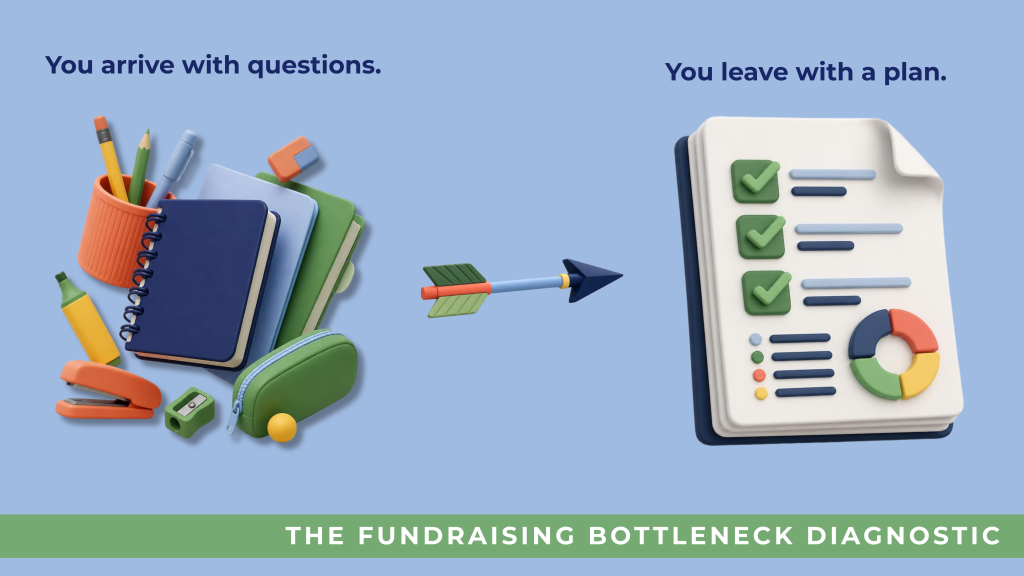
WHAT YOU WALK AWAY WITH.
- The survey. About ten minutes on how the practice actually runs today.
- The call. Forty five minutes on the bottleneck itself. No warm up, no orientation, no recap of what you already told me.
- The Bottleneck Brief. Five to seven pages, in your hands within five business days, written as an attachment you can forward to a board chair without editing it first.
What THE BRIEF SAYS.
- Top issues. What is costing you, named plainly, in order of what it is costing.
- Action steps. What to do, in sequence. The first one is written so you could start it Monday.
- Recommended outcomes. What each step should produce, so you know whether it worked rather than whether it happened.
- Benchmarks. How to check yourself in ninety days without me in the room.
Where this stops.
This locates the bottleneck and tells you what to do about it. It does not build the system and it does not run it. When you are ready to put the findings into motion, the Infrastructure Build takes it from there.
WHAT IT COSTS.
$599. Survey, forty five minute call, and your Bottleneck Brief within five business days. You will leave with everything you need to take the next step, with your team or with me. Either way you will stop guessing, which is the part that has been expensive.
Your diagnostic fee applies toward a larger engagement if you book one within two weeks of your session. That applies to a Fundraising Operations Audit, an Infrastructure Build, or an Operational Transition. I built it that way because the diagnostic should be worth the money whether or not it turns into anything else.