


The Cost that Does not Show up on the Surface
Ask a firm leader whether their operations are working, and the honest ones will usually say some version of fine. Ask what is not happening because of it, and the answer gets longer.
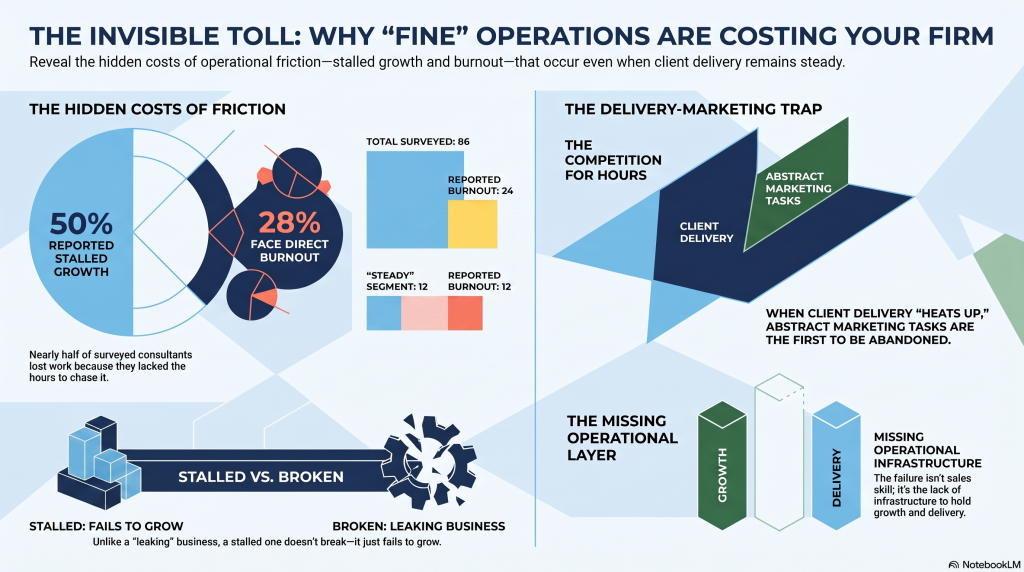
The 2026 Consulting Almanac asked 86 independent consultants whether operational friction had cost them anything in the last year. Almost none of them lost a client or missed a deadline. Delivery held. What nearly half of them named instead was delayed growth, work that never happened because nobody had the hours to chase it.
That distinction matters more than it looks. A leaking business shows itself. A stalled one does not, because nothing visibly breaks. The reputation holds. The client base holds. The capability is proven. What is missing is invisible, because it never existed in the first place. It just did not get built.
The almanac also asked what that friction cost the person underneath it. 24 of the 86 named burnout directly. Among the group who reported both keeping up and working okay, the steadiest-looking segment of the whole survey, 12 still reported burnout. Steady and burned out are not opposites. They can describe the same person in the same month.
There is a mechanical reason this keeps happening, and it shows up whether the operator is a solo consultant or the embedded partner running point for a firm. Marketing and delivery compete for the same hours. When a client engagement heats up, the client is in the room and the future pipeline is abstract, so marketing is the first thing set down. The pipeline goes quiet. The practitioner reads that quiet as a sales problem and tries to market harder next time, and the cycle repeats, because the actual gap was never sales skill. It was an operational layer that never got built to hold marketing and delivery at the same time.
If your firm relies on someone carrying all of this personally, staff or outside partner, the numbers on the surface can look completely fine while two real costs stack quietly underneath: the growth that never got claimed, and the person who is running out of room to carry more.
Neither of those shows up in a status update. Both of them show up eventually, usually at the worst possible time, when a client engagement is heating up and there is no room left to absorb anything new.
The final post in this series looks at what is actually buildable from here, and why the fix is smaller than most leaders assume.
Read the full findings in The 2026 Consulting Almanac.
Erin Peshoff is the Founder of Vivid Operational Advisors. She has spent thirty years inside nonprofit operations, helped raise over $100 million for institutional missions, and built Vivid around the operating discipline most strategic engagements skip.