

The Founder Bottleneck
Every decision in the firm still comes back to the founder, and it shows up everywhere: the escalations, the scope questions, the calls that actually require someone to decide something, all landing on the same calendar, and the founder usually explains this to themselves as a delegation problem, something they would fix if they just got better at handing things off.
But the big problem is that there was nothing to hand off. Ownership in a small firm is usually implicit rather than absent, so one person ends up holding every decision right by default, from the early days when there was no one else around to hold it, and nobody ever sat down and decided the founder should still be making every call three years and five hires later. It just never got revisited.
That is why the fix is not delegation, but architecture. Delegation assumes the job already belonged to someone else and just needs to move. What the firm actually needs is decision rights and escalation paths written down and matched to how it runs now, not how it ran with one person and a laptop, and any approval that exists only for the founder’s comfort rather than because it changes a client outcome should be cut. Whatever sign-off survives should survive because it matters, not because it always has.
None of this is about the founder learning to let go. It is a matter of deciding, on paper, who owns what, sized to the firm as it is now rather than as it started, so that once the decision exists, someone on the team can act on a client’s behalf because they hold the authority, not because the founder finally relaxed enough to allow it.
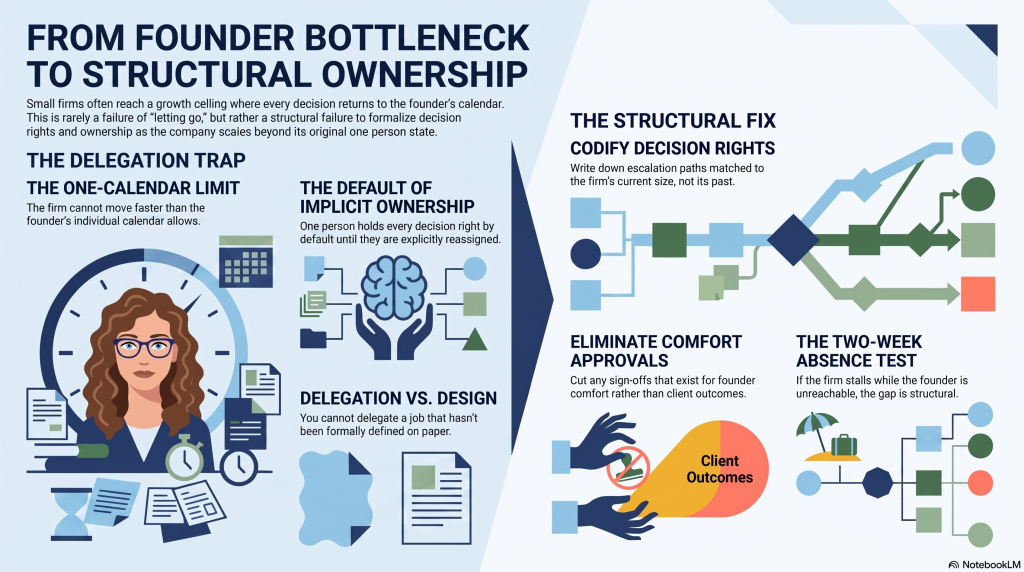
Here is the test. The founder goes away for two real weeks, unreachable, no email. If delivery keeps moving and no client notices, ownership is distributed. If something stalls or quietly breaks instead, the firm is still running on one calendar, and no amount of trying to delegate harder changes that.
The firm cannot move faster than one calendar allows, and growth does not stall because a founder is bad at letting go. It stalls because the gap was structural the whole time, and nobody got around to closing it.
See where ownership and eight other systems in your firm currently stand. This self-placement mirror takes about the length of a coffee break. Give it a go and let me know what you think.
Erin Peshoff is the Founder of Vivid Operational Advisors. She has spent thirty years inside nonprofit operations, helped raise over $100 million for institutional missions, and built Vivid around the operating discipline most strategic engagements skip.