

Muscle Memory, Not Magic
Who remembers AOL? The disc in the mail, the dial up you fought your siblings over, the whole world arriving through one screeching modem sound.
I remember it well. My first grown up solicitation, the first ask I ever made on my own, went to an AOL employee just as the company was exploding in 2002. I moved to Ashburn, Virginia in 2004, the heyday of AOL’s headquarters. 22 years ago. Ashburn did not stay the AOL town. It became a data center town, one of the largest concentrations of them anywhere.
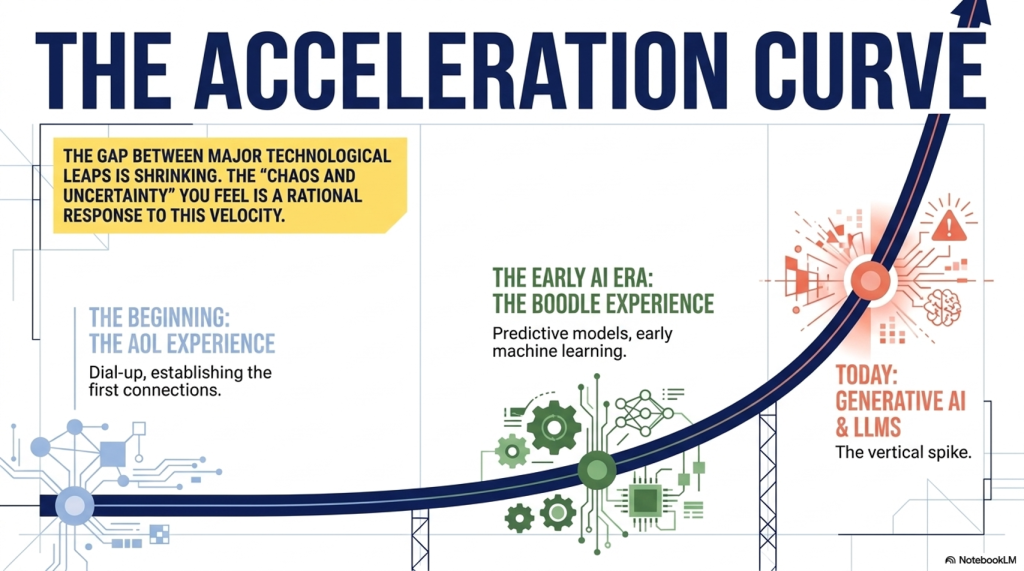
The gap between that world and this one keeps shrinking. The first time I heard about generative AI, I hated it. It scared me. Most of the fundraisers I talk to feel the same thing, and nobody has given them permission to say it out loud. Everything is moving so fast it feels like we cannot possibly keep up.
The truth is that nobody knows what happens next, and anyone who tells you they do is lying. What we do know is this: $644 billion dollars went into AI in 2025, and Carnegie Mellon research found it still fails at basic tasks seven times out of ten. Ninety five percent of pilots never reach scale. Underneath the hype sits a real cost in water and energy that most of the conversation skips past entirely.
The organizations struggling with AI are not struggling because the tool is wrong. They are struggling because nobody built the ritual that holds it. Just look at the stats from Blackbaud Institute:
- 10% AI-Adaptive vs. 75% AI-Emerging. Only one in ten organizations has moved past fragmented, individual AI use into something systemic and mission-aligned. Three-quarters are stuck in scattered experimentation.
- 75% revenue growth vs. 48%. AI-Adaptive organizations report increased revenue at a much higher rate than their less mature peers, and they are nearly twice as likely to exceed their revenue goals (34% vs. 19%).
- Only one-third believe their AI use is very effective. This is the effectiveness gap in one number: adoption is nearly universal, but most professionals do not trust that their organization is getting real value from it.
- 76% of donors want AI disclosure, only 26% of organizations provide it. The transparency gap is the widest of the four gaps in the report, and it is the one most directly tied to donor trust.
- 621 hours saved per week for AI-Adaptive organizations vs. 503 for the sector average, translating to 11 to 13 hours a week for leadership and Millennial staff specifically. The dividend only shows up when those hours get reinvested into cultivation and mission work rather than absorbed as scattered time savings.
As per above, a lot of numbers get thrown at this problem. Here is the one that changed how I think about it. Only four percent of organizations have a documented, repeatable workflow.
That is not a stat about AI. That is a stat about us, and it is the one piece we can actually control before we touch a prompt.
Here is where I got the word for what happens instead. I was thinking about my long ago marathon training and how one missed long run turns into a missed week, which turns into a training block that quietly stopped looking like the plan I wrote back in January. It happened one small skip at a time. I started calling that the drift, and once I had the word I saw it everywhere in my clients’ operations. Decisions that slide instead of closing. Donors who go quiet and nobody notices until the gift does not come in. Habits that come back after everyone already agreed to stop them.
Start with something that has nothing to do with AI. Document what your team actually does, every day. If you cannot describe a process clearly, AI will inherit the confusion. Organizations ready for AI have already done that work. The rest are in for an expensive year.
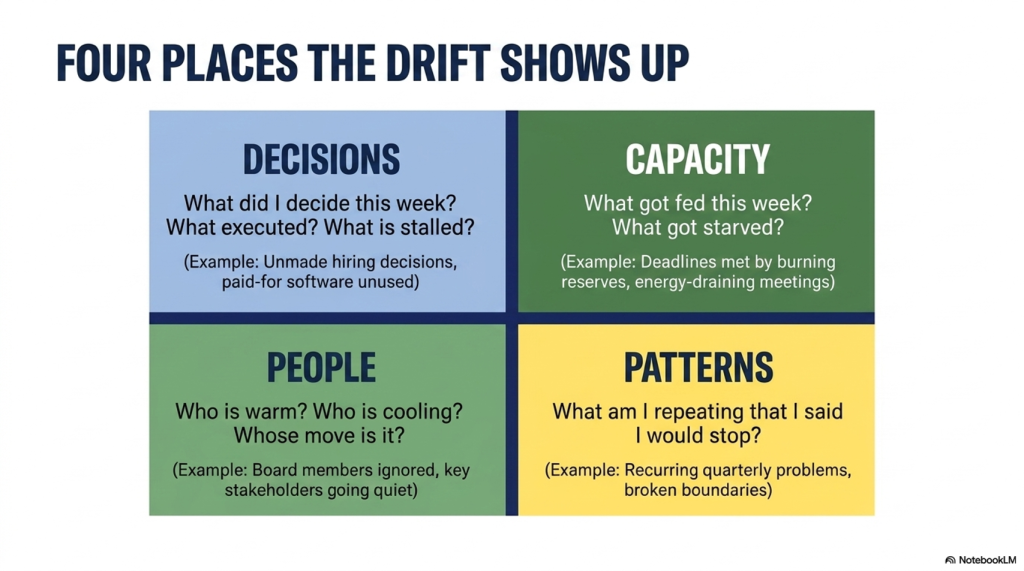
So the takeaway is not a tool recommendation. It is a ritual: four questions, answered every Friday. What did I decide this week, and what is still stalled. What got fed and what got starved. Who is warm and who has gone quiet without me noticing. What am I repeating that I already said I would stop.
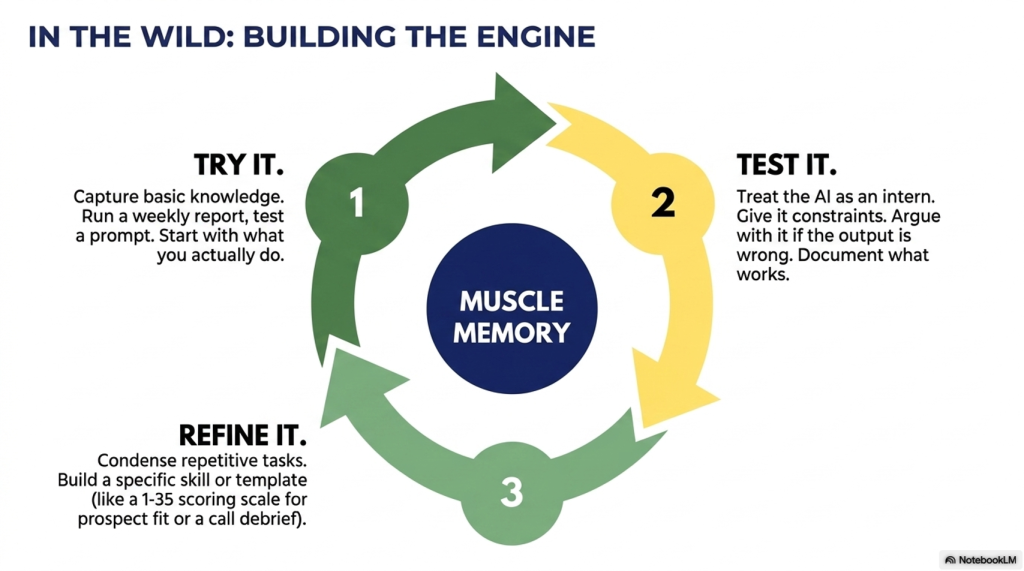
Treat the AI you already have the way you would treat an eager new intern, not an oracle. Give it constraints. Argue with it when the output is wrong. Let it miss on the first try, because that is how the muscle gets built.
A final thought… As leaders in this sector, we have an obligation to keep the human side in view through all of it. For me that means four things: identity, structure, community, contribution. Lose track of those and the tool doesn’t matter.
If you were in that room in New Orleans, thank you for joining me. If a colleague forwarded you this instead, the full version of the ritual, along with the worksheet and the prompts from the talk, lives in The Drift for Nonprofits. It is free to download and built to travel, so use it, teach it, and share it with the credit line intact.
Erin Peshoff is the Founder of Vivid Operational Advisors. She has spent thirty years inside nonprofit operations, helped raise over $100 million for institutional missions, and built Vivid around the operating discipline most strategic engagements skip.