
For NONPROFIT
Organizations.
Your mission is not the problem. The infrastructure holding it together is.

FOR Nonprofit Organizations
Your mission is not the problem. The infrastructure holding it together is.
OPERATIONS WITH A FUNDRAISER’S EYE
For NONPROFIT
Organizations.
SOUND FAMILIAR?
Nine Systems. Three Groups.
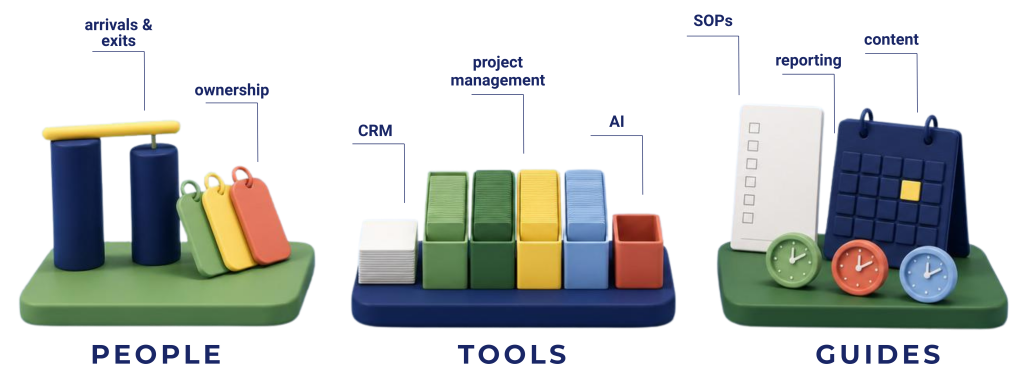
The sequence runs across nine systems, in three groups. People, meaning arrivals, exits, and ownership. Tools, meaning your CRM, project management, and AI workflows. Guides, meaning SOPs, reporting, and content planning. Those nine are where the four sentences above come from, and any one of them can be the reason the other eight feel heavy.
How we work.
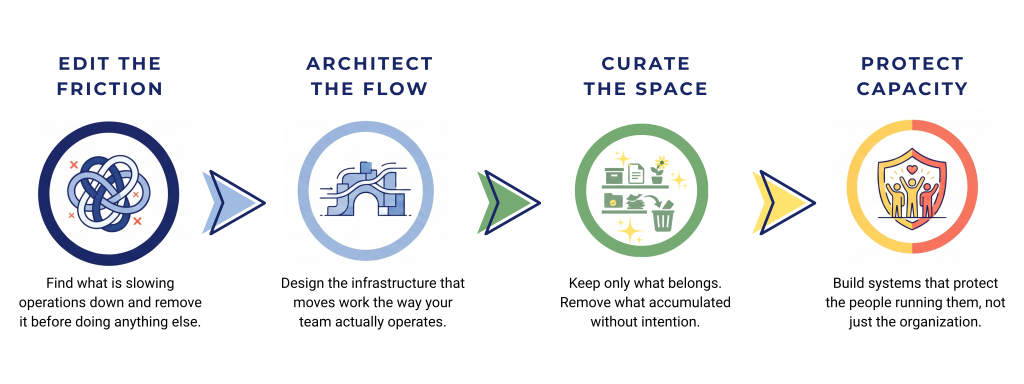
Four moves created with lots and lots of trial and error. Almost every operations engagement in this sector starts at the second move, because building looks like progress and cutting looks like nothing happened, so the new database goes in on top of the old mess, the mess comes along with it, and eighteen months later somebody decides the database never worked. We edit first because we spent years watching it happen the other way and seeing fundraising suffer.
Your Assessment
Nine systems sit underneath every fundraising operation. Three of them are about people, meaning arrivals, exits, and ownership. Three are tools, meaning your CRM, project management, and AI workflows. Three are guides, meaning SOPs, reporting, and content planning. Nine questions, one for each, and you will know which ones are holding and which ones are running on one person. Nothing gets sent to us, and nothing about this is a pitch. It is the same read we run at the start of every engagement, in the short version you can do yourself in about five minutes.
Your CRM and your onboarding are almost never at the same stage.
Nine systems sit underneath how your organization runs, and they mature at different speeds. One is protected. Two are still running on somebody’s memory. Most organizations have never looked at them side by side.
This places each of the nine. It takes about five minutes, and there is nothing to fix by the end of it, only something to see.
A list of everything broken and a plan to build more.
A stage for each system, including the ones that are already fine and should be left alone.
Your operation is holding, and it is running through people more than systems.
That is the frontier, not a failure. The work is getting done. What is missing is the system underneath it, and that is the most buildable problem there is.
Most of your operation is steady. One or two systems are carrying more strain than the rest.
Steady is a real accomplishment. It is also the state that never generates its own reason to move. The systems below the line are where the next gain is.
Your infrastructure is in strong shape. What is left is refinement, not repair.
You have built more than most organizations ever reach. The domains below are the last edges, not open wounds.
Where to Start
Find the one thing costing you most.
The assessment shows you where each of the nine systems stands. The Fundraising Bottleneck Diagnostic finds the one that is doing the most damage, and hands you the steps to clear it. A short survey, forty five minutes, and a written brief within five business days.
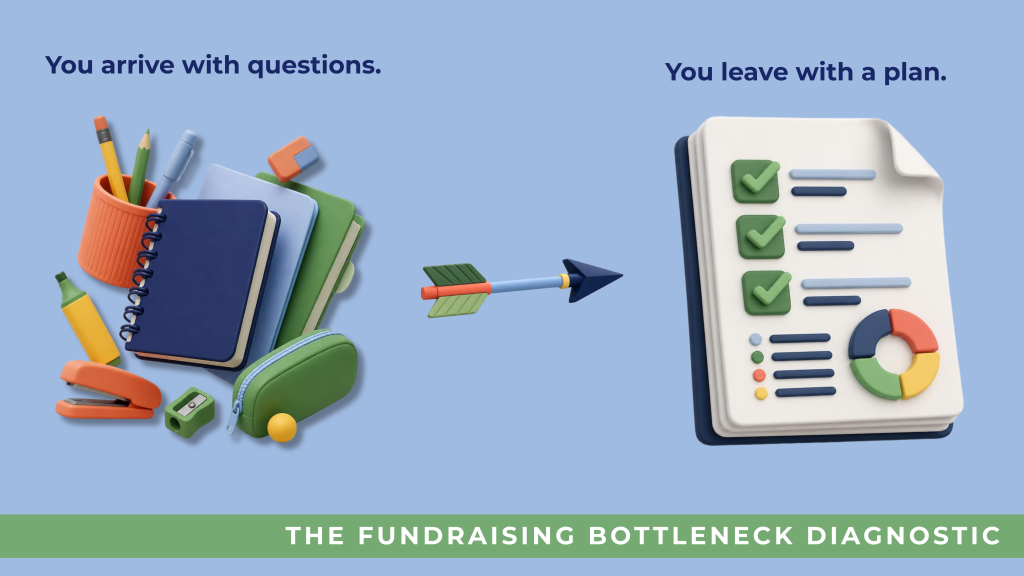
You answer a short survey mapped to the nine systems in the Editor-Architect Framework, People, Tools, and Guides. We read it before you show up, so the forty five minute call is spent on what matters. From there you get a written report naming what is costing you and what to fix first.
- The survey. About ten minutes, mapped to the nine systems underneath a fundraising operation.
- The call. Forty five minutes on the bottleneck itself, because I have already read your survey.
- The Bottleneck Brief. Five to seven pages, in your hands within five business days, as an attachment you can forward.
Find the one thing costing you most.
The assessment shows you where each of the nine systems stands. The Fundraising Bottleneck Diagnostic finds the one that is doing the most damage, and hands you the steps to clear it. A short survey, forty five minutes, and a written brief within five business days.
You answer a short survey mapped to the nine systems in the Editor-Architect Framework, People, Tools, and Guides. We read it before you show up, so the forty five minute call is spent on what matters. From there you get a written report naming what is costing you and what to fix first.
- The survey. About ten minutes, mapped to the nine systems underneath a fundraising operation.
- The call. Forty five minutes on the bottleneck itself, because I have already read your survey.
- The Bottleneck Brief. Five to seven pages, in your hands within five business days, as an attachment you can forward.
What the work looks like
The diagnostic tells you what is costing you. These three are how it gets fixed. Once you can see which systems are weakest, the shape of the work follows from what you found. Every engagement is scoped to where the organization actually is, and these are the three forms it takes.THE Next Step.
This is not about adding more. It is about removing the systems failures that cost you donors, exhaust your gift officers, and make your campaigns land smaller than they should. A cross-functional workflow your team can run without you. Reports that exist when the board asks. A way of working that does not depend on three people remembering. The assessment shows you where the systems stand. A conversation is where you decide what to do about the one costing you most.

When fundraising falls short and nobody can explain why, look underneath it.
Before the Edit walks you through the nine systems that sit under every fundraising operation, one at a time, so you can see for yourself what is already there and what needs to come out before anything new goes in. Download your copy and do the first look yourself.